
Checking Criminal History in Peachtree City
Choose the source by document type. Peachtree City Police is the first stop for a city-created incident or accident report. Municipal Court is appropriate only when the citation assigns the matter there. Fayette County offices hold county court and jail records, while the Georgia Bureau of Investigation maintains the central criminal-history repository.
- Start with the Peachtree City police information page and its NextRequest channel for a city incident.
- Give correct names, dates, addresses, and identifying details; upload photo identification when seeking an unredacted report about yourself.
- Read the checked court box on a citation before contacting Municipal Court.
- Use Fayette County criminal court cases and county arrest lookup for prosecution or custody records outside city jurisdiction.
- Use the GBI process when the goal is a statewide Georgia criminal history rather than one local file.
These steps also prevent a common false negative. A quiet municipal-court response says nothing about a citation sent to State or Juvenile Court, and a police report does not supply the final judgment.
NextRequest for Peachtree City Police Records
NextRequest is the named channel for Peachtree City police information. A precise request should identify the event rather than ask broadly for “everything.” Include the involved name, event date, location, and report or case number if known. Staff communicates the cost, and protected content may be redacted. An unredacted report about the requester requires uploaded photo identification; a request involving another person does not gain the same access merely because a name is supplied.
The official NextRequest and report directions show how Peachtree City separates ordinary reports from collision retrieval.
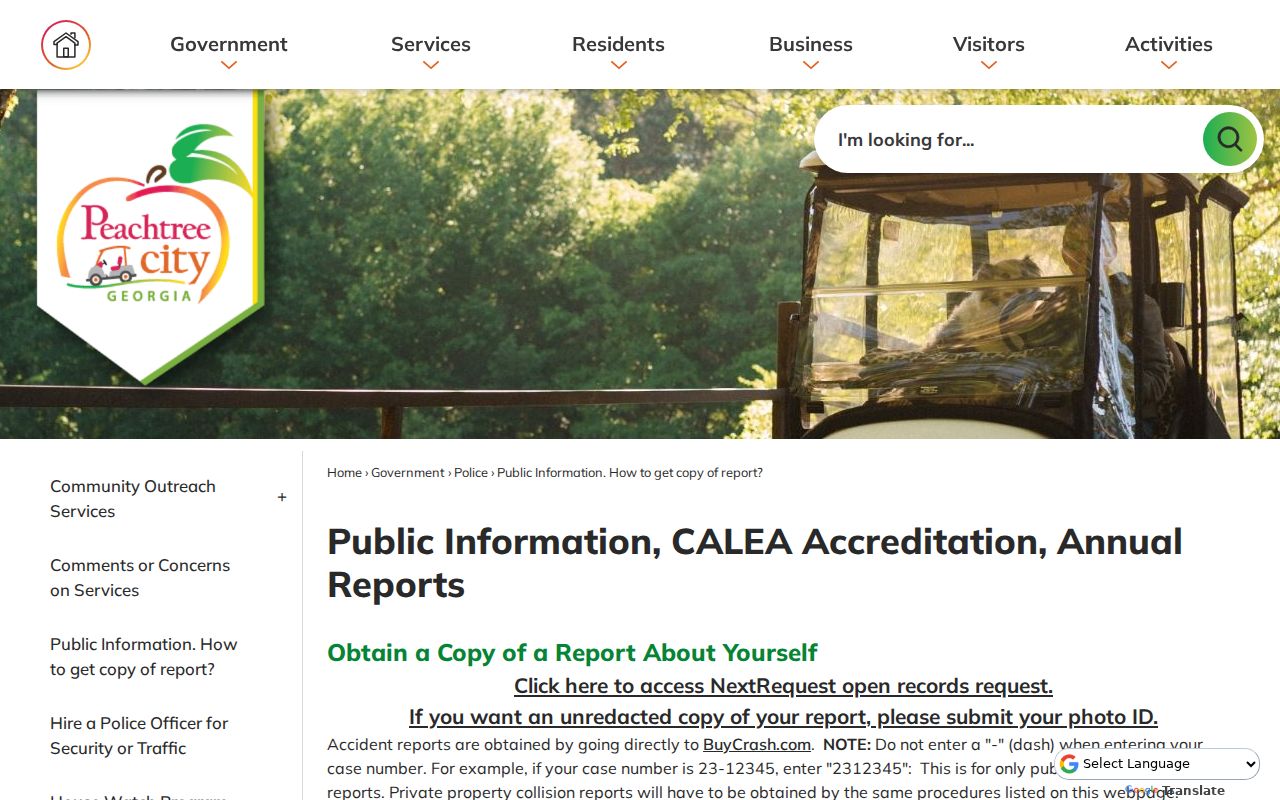
The captured directions matter because a public-road collision and a private-property collision follow different paths even when Peachtree City Police handled both.
Peachtree City Police Department Records
Peachtree City Police Department is at 350 South Highway 74, Peachtree City, Georgia 30269. The main number is 770-487-8866, fax 770-631-2512, and the records email is policerecords@peachtree-city.org. Its file can contain the initial call information, officer narrative, involved-person details, property or vehicle information, arrest references, and attachments that remain releasable.
That material is not a “rap sheet.” A local police file describes an event investigated by Peachtree City officers. The GBI history aggregates reportable Georgia criminal-justice events, and a court file records prosecution and disposition. Matching the request to the right custodian saves time and avoids treating allegations as convictions.
Peachtree City Crash Numbers Drop the Dash
Peachtree City's BuyCrash instruction has a small but important formatting rule: remove the dash from a public-roadway collision case number. A case written as 23-12345 should be entered as 2312345. Public-roadway reports use BuyCrash, while private-property collision reports go through the ordinary police-record request. Failure to make that distinction can look like a missing report when the real problem is the channel or number format.
Quick answer: Use BuyCrash for a public-road collision, remove the case-number dash, and use NextRequest for a private-property collision. Costs for an ordinary request are communicated by staff.
Peachtree City Arrests and Bookings
Peachtree City Police creates the city arrest or incident report, but Fayette County operates the county jail at 155 Johnson Avenue in Fayetteville. No separate Peachtree City jail roster was verified. For the narrative explaining what officers reported, request the Peachtree City police file. For current custody or booking status, use the Fayette County Sheriff's jail channel.
A booking entry and an arrest narrative answer different questions. Booking data concerns intake and custody. The police report describes the alleged event. A filed prosecution belongs to the appropriate court, and only its disposition establishes how the case ended. Initial charges can change, so compare names, dates of birth, case numbers, and court outcomes before drawing conclusions.
Three Courts Can Receive Peachtree City Citations
A citation issued by a Peachtree City officer does not automatically belong in Peachtree City Municipal Court. The official citation information identifies three possibilities: Municipal Court, Fayette County Juvenile Court for a person age 16 or younger, or Fayette County State Court. The checked box on the citation controls the route.
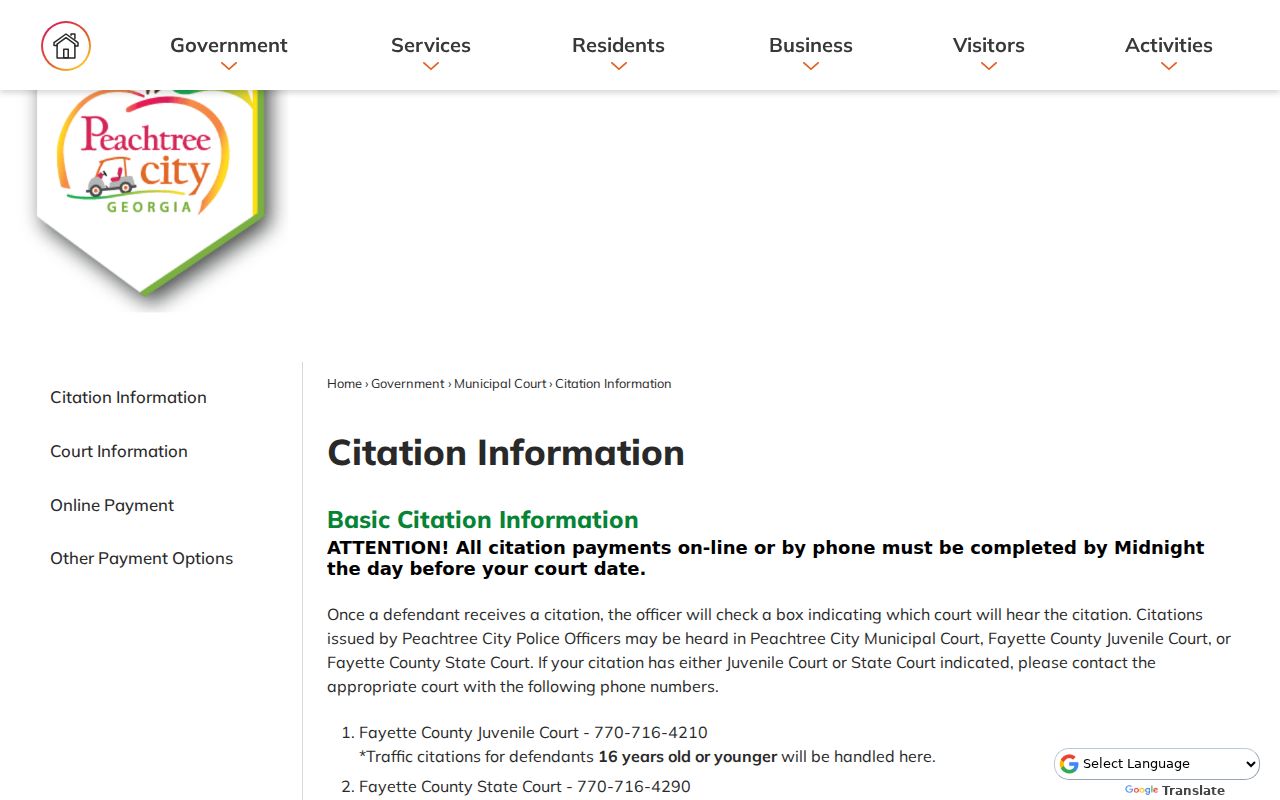
This routing explains why a search limited to one court may miss a real matter. Ordinary citations need about two business days for processing, while accident citations may need three. Contacting a clerk before that window can produce a temporary “not found” result.
Municipal Court Records in Peachtree City
Peachtree City Municipal Court temporarily serves the public at 201 Willowbend Road; mail goes to 151 Willowbend Road, Peachtree City, GA 30269. The phone is 770-487-7657. Window hours are 8:30 a.m. to 4 p.m. Monday, Tuesday, Thursday, and Friday, and 8 a.m. to 5 p.m. Wednesday. No public municipal name-search portal was located, making the citation and clerk direct routes important.
| Court Name | Peachtree City Municipal Court |
|---|---|
| Case Types Heard | Assigned city ordinance and traffic citations; the checked citation box determines jurisdiction |
| Case Lookup Channel | Citation information and direct contact with the municipal clerk |
| What the Docket Shows | Citation, scheduled event, plea or adjudication, judgment, fine, and disposition when entered |
| Copies & Fees | Ask the clerk for availability and a cost estimate; no universal copy fee was verified |
What Peachtree City Record Terms Mean
An incident report is the police account of an event. An arrest is a custodial action, not proof of guilt. A citation orders a person to answer an alleged violation in the named court. A docket is the court's event index and may not include the underlying document image. A disposition is the recorded outcome, such as dismissal, plea, or judgment. A GCIC history is the state repository response and is not interchangeable with any one of those city records.
Identity deserves equal care. A name match is not fingerprint verification. Compare date of birth and other lawful identifiers, and use the GBI fingerprint-based review route when certainty about one's own statewide history matters.
Where Peachtree City Records Go
A Peachtree City event begins locally, but the complete paper trail can spread. Police retain their investigative report. A municipal citation stays with the city court only when assigned there. Felony and county misdemeanor prosecutions move through Fayette County's trial courts, and reportable case outcomes ultimately feed Georgia's central repository.
Record flow: Peachtree City Police Department › Fayette County Courts › Georgia Bureau of Investigation
Recent activity is most likely to appear first with police or the booking custodian. A fully processed case should be checked with the court. A statewide personal history comes from the GBI. For the county system as a whole, use the Fayette County criminal history overview.
Peachtree City Requests Beyond Police
Citywide administrative records may go through the Peachtree City Clerk. The city does not require a mandatory form, and it supplies an estimate before costs are incurred. That route should not be used as a substitute for the police channel when the desired document is clearly a police report, nor for the court clerk when the desired record is a judgment.
- Use NextRequest for police information and private-property collision files.
- Use BuyCrash for public-roadway collision reports.
- Use the court named on the citation for the case outcome.
- Use the City Clerk for other city-government records.
- Use county or state custodians only when the record has moved beyond city scope.
Public Access Rules in Peachtree City
Georgia's open-records law applies to releasable Peachtree City agency records, but it does not erase confidentiality rules. Active-investigation material, juvenile information, victim information, body-camera content, and protected personal data may be withheld or redacted. A response or cost notice within three business days is not necessarily completed production. Court sealing and record restriction can also change what a public search reveals.
Key Statutes:
Georgia Open Records Act, O.C.G.A. § 50-18-71 - governs inspection, copying, response, and lawful charges for public records.
O.C.G.A. § 35-3-35 - controls dissemination and inspection of Georgia criminal-history information.
O.C.G.A. § 35-3-37 - provides Georgia's record-restriction and correction framework.
Correcting a Peachtree City Record
When a Peachtree City record looks wrong, identify which layer contains the error. Ask police for the source report if the event facts or identity appear incorrect. Obtain the disposition from the court if a charge changed or ended. Then use that documentation with GCIC when the state history is the layer needing correction. GCIC cannot independently rewrite an originating police or court record.
Restriction is also different from correction. Georgia's process can limit public dissemination for eligible records, but it does not make every agency file vanish. Verify the result in both the relevant court view and one's GCIC history rather than assuming that a completed form changed every system simultaneously.
Keep a simple record of each Peachtree City request: the submission date, reference number, exact description, custodian response, estimated cost, and documents received. That history helps when the same event has both a police case number and a court citation number. It also makes a follow-up specific instead of forcing staff to reconstruct the first request.
Read every returned document in time order. An initial offense description may be followed by an amended charge, dismissal, plea, or judgment. Redaction marks do not necessarily signal that the file is incomplete; they may reflect a lawful privacy exception. If a needed item is absent, ask the identified custodian whether it is maintained elsewhere, sealed, temporarily in court, or not yet created.
For one's own Peachtree City history, fingerprint comparison offers stronger identity assurance than a public name match. For a single city incident, however, a focused report request plus the corresponding court disposition usually provides the clearest explanation. The most reliable result is a reconciled set of source records, not a broad conclusion drawn from one screen.