
Finding Arrest Records in Fayette County
Start with the Sheriff's official inmate lookup page for present custody or a recent Fayette County booking. The direct endpoint returned an access error during research, so an empty or failed page should lead to the jail phone and records channels, not to a private people-search site. Call the jail at 770-716-4720 when current custody must be verified.
- Check the official inmate-lookup page for current county custody.
- Call the jail if the endpoint fails or the result needs confirmation.
- Request the narrative from the agency whose officer made the arrest.
- Check the Clerk docket for filed charges and the final outcome.
A city police report remains with that city department even if the Fayette County Jail handled booking. County dispatch does not merge Fayetteville, Peachtree City, Tyrone, and Sheriff reports into one report repository.
What the Fayette County Jail Records Clerk Maintains
Official job-duty material supports a detailed view of the jail's internal record work. The records clerk handles commitment sheets, fingerprint cards, warrants, citations, GCIC and NCIC transactions, booking data, bond-fee invoices, Offender Management System records, sentence information, and courthouse file transport. That inventory explains what can exist behind the search page without claiming that every item appears online or is public.
| Booking identity | Name and intake identifiers used for the detention event |
|---|---|
| Custody data | Commitment, sentence, release, and Offender Management System information |
| Charge process | Warrants, citations, initial allegations, and related transactions |
| Identity records | Fingerprint cards and GCIC or NCIC work |
| Bond records | Bond-related information and fee invoices maintained internally |
Public access can be narrower than internal retention. Medical, victim, juvenile, active-investigation, protected identity, and law-enforcement system data may be restricted or redacted.
Fayette County Booking Is Not a Finding of Guilt
Booking documents detention and the allegations known at intake. A prosecutor may decline a charge, file a different charge, or amend it. A court may dismiss a case, accept a plea, acquit after trial, or enter a conviction and sentence. Release from the jail can occur before the court case ends.
| Booking or arrest record | Court case record |
|---|---|
| Created by an arresting agency and jail | Maintained by the Clerk after filing |
| Shows detention and initial allegations | Shows filed charges and judicial events |
| May include custody and bond status | May include plea, judgment, sentence, dismissal, or acquittal |
| Does not prove guilt | A guilty judgment establishes conviction |
Note: A Fayette County arrest entry is not proof that the person committed the alleged offense or was convicted.
Requesting a Fayette County Arrest Report
The Sheriff's resources page separately links Records, Traffic, Open Records Request, Incident and Accident Records Request, Mug Shot Request, and restriction materials. Use the incident or accident request for a Sheriff-created narrative. A qualifying collision may also have an official BuyCrash route. No current universal Sheriff copy fee was found, so requesters should ask for an estimate rather than relying on a borrowed figure.
A precise request should identify the agency, incident date or range, location, report or incident number if known, record type, and preferred format. Under the Georgia Open Records Act, a written request preserves enforcement rights and the agency generally responds within three business days with access, timing and cost information, or a cited exemption. That response window is not a promise of completed production in three days.
The official Sheriff resources hub separates the available report and records channels.

From Fayette County Intake to First Appearance
Intake generally involves identity checks, fingerprints, a booking photograph, property inventory, and screening. A judicial officer then addresses lawful custody and bond. Exact Fayette classification practices, medical-screening details, first-appearance timing, housing procedures, and release steps were not published in the reviewed official sources and should not be filled with assumptions.
Magistrate Court handles warrants, first appearances, and preliminary criminal process. A warrant application, issued warrant, booking, first appearance, and final judgment are different events. A felony matter may later move into Superior Court, while a misdemeanor can proceed in State Court. City ordinance or assigned traffic matters can remain in municipal court.
Bond is not a fine: The jail or issuing court must confirm type, amount, conditions, holds, and the proper payment recipient.
When the Fayette County Inmate Search Fails
The direct inmate endpoint returned HTTP 406 during inspection. That technical result does not mean no one is in custody and does not make a third-party roster authoritative. Use the Sheriff's inmate-lookup shell, call the jail at 770-716-4720, or submit an official request for releasable booking information.
A person can also be absent because release occurred, transfer took place, another county holds the person, or custody is state or federal. Georgia Department of Corrections Find an Offender covers state-sentenced custody, while federal custody uses the Bureau of Prisons. A Fayette County jail result should never be described as a search of all custody systems.
The Sheriff provides an official inmate-search entry page even when its direct tool is unavailable.

Recent Fayette County Arrest Information
The Sheriff press-release archive can document selected arrests and enforcement initiatives, but it is not a complete booking ledger. Publication decisions, release timing, and the focus of an announcement determine what appears. Absence from that archive proves nothing about a person's arrest history or current custody.
This page republishes neither arrestee names nor mugshots. Readers seeking a specific official record should use the jail, arresting agency, and court channels. A press release still describes allegations at that stage and should be checked against the later Fayette County court disposition.
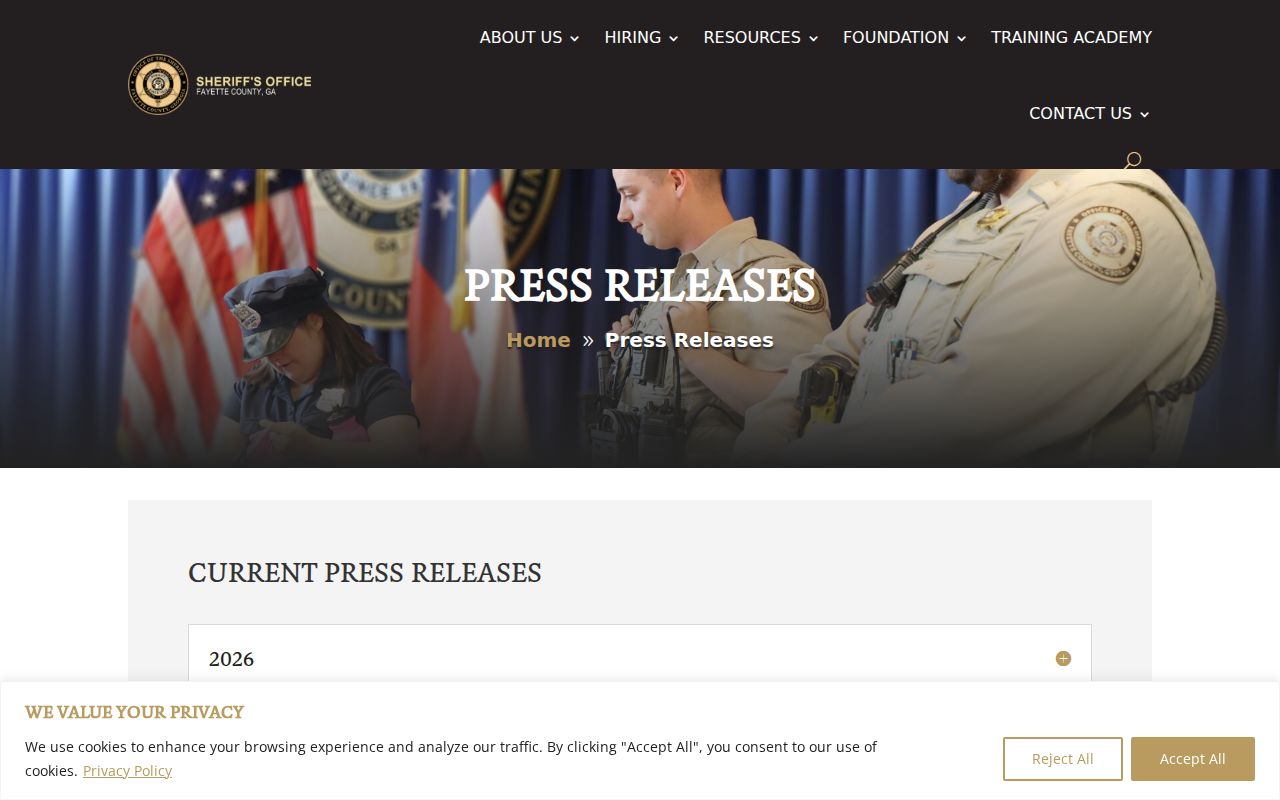
The official Sheriff press-release archive offers limited recent context.
Arresting-Agency Routing in Fayette County
Ask which officer or department created the report. Fayette County Sheriff records go through Sheriff channels. Fayetteville Police, Peachtree City Police, and Tyrone Police each retain their own agency reports. The county open-records hub separately routes 911 calls for the Sheriff, Marshal, county fire and EMS, Fayetteville police and fire, Peachtree City police and fire, and Tyrone Police.
| Needed record | Official custodian |
|---|---|
| Current booking or custody | Fayette County Jail |
| Incident or arrest narrative | Arresting police or Sheriff agency |
| 911 call or dispatch material | County 911 request route |
| Filed charge and disposition | Clerk or the relevant municipal court |
| Georgia identity-based history | GCIC through an authorized channel |
Following a Fayette County Arrest Into Court
After finding a booking, search the Fayette County criminal court case channels. Compare the initial allegation with the accusation or indictment, docket events, and final disposition. The web docket can omit images, so call the Criminal Division at 770-716-4293 or request the named document when a definitive outcome is needed.
A missing disposition can reflect reporting lag or a source agency that has not transmitted an update. For an audit of one's own Georgia history, obtain the broader GCIC record through an authorized self-review channel, match each OTN-linked arrest cycle to the arresting-agency report, then match it to the court outcome.
Fayette County Arrest Records and Restriction
Georgia calls the process record restriction. It generally hides eligible history from ordinary public dissemination rather than destroying it. Eligibility is charge-specific, so different charges within one arrest cycle can have different outcomes. Restriction also differs from correction: correction fixes inaccurate source data, while restriction limits dissemination of eligible accurate data.
For an arrest before July 1, 2013, the process begins with the arresting agency and moves to the prosecutor. For a later arrest, contact the prosecutor directly. If approved restriction cannot be entered electronically, GCIC accepts the approved packet and applicable state fee. Verify completion in both the GCIC history and the relevant local display.
A denial can be appealed to Superior Court within 30 days. An ordinary conviction does not fit the basic nonconviction route, though First Offender discharge and separate conviction-restriction laws may apply. Restriction also does not automatically remove an old agency release or every court document, which is why each Fayette County source must be checked after the process ends.