
Checking Criminal History in Fayetteville
Fayetteville has unusually clear city routes, but each answers a different question. The police reporting page handles city-created reports. The Municipal Court clerk provides its own records. Fayette County maintains county prosecutions and jail data. The GBI supplies the statewide criminal-history layer.
- Use the Fayetteville Police channel for an incident, crash, or officer-created report.
- Wait the published three to five business days before looking for a crash report.
- Request the city-court record through its online, mail, fax, in-person, or email route.
- Move to Fayette County court records or county booking records when the matter falls outside municipal jurisdiction.
- Use the GBI's official process for a statewide history or fingerprint-based self-review.
Never substitute an arrest allegation for a disposition. The police report describes the event, while the court record establishes the adjudicated result.
Fayetteville Online Police Report Categories
The Fayetteville Police report page supports crime tips, custody-order violations, harassment, hit-and-run, identity theft, lost property, minor crashes, miscellaneous reports, noise complaints, supplemental information, theft, traffic complaints, vandalism or trespass, and vehicle burglary. The online option is not for an emergency or an event with a suspect still on scene; call 911 in that situation.
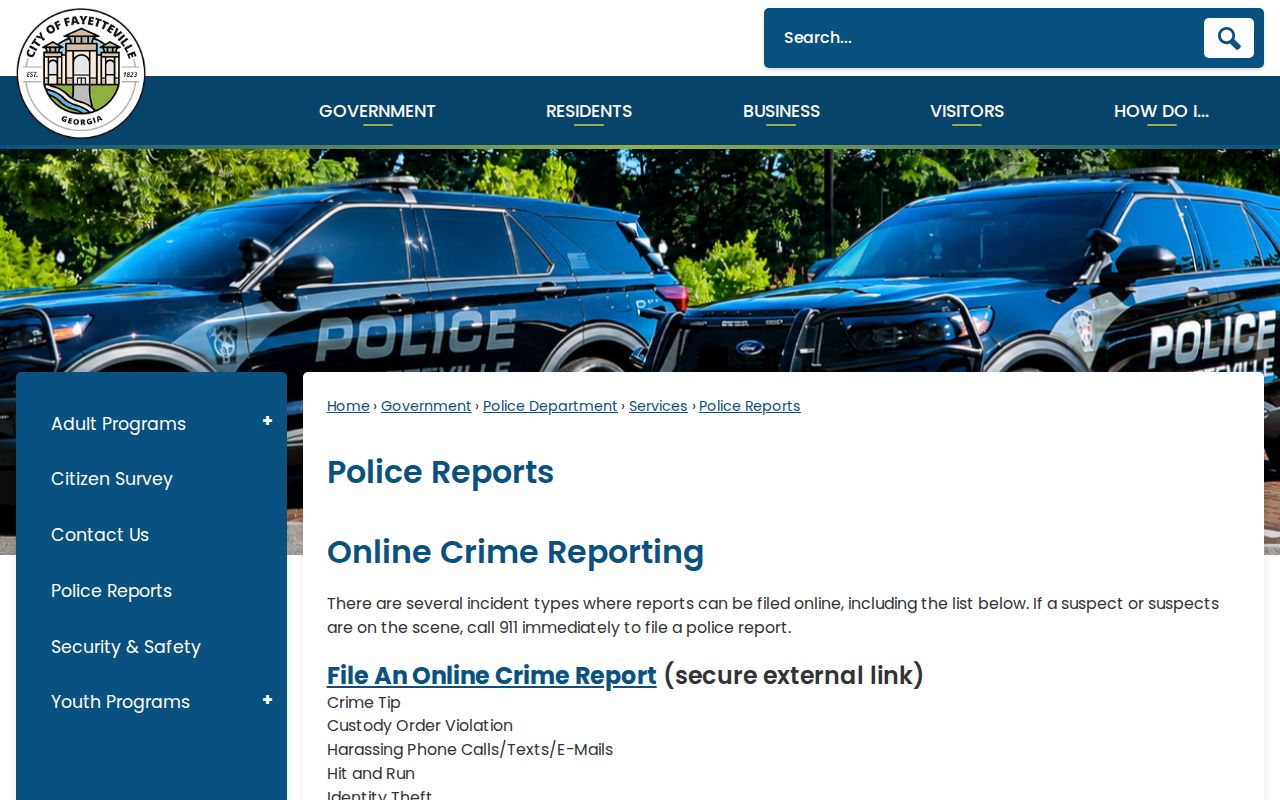
The categories show that Fayetteville online reporting is an intake channel, not a public name-search database. Requesting an existing report and submitting a new report are separate actions.
Fayetteville Police Department Records
Fayetteville Police is at 760 Jimmie Mayfield Boulevard, Fayetteville, GA 30215. The main number is 770-461-4441 and dispatch is 770-461-4357. Police records may include the call or complaint, narrative, involved-person and property details, arrest references, and releasable attachments. Protected or active-investigation content may be withheld or redacted.
Crash reports are available at the lobby or through LexisNexis after three to five business days. That window reflects processing, so an immediate failed search does not establish that no report exists. County 911 audio or CAD follows the county's separate 911 request route rather than the city police-report route.
When Fayetteville Requires 911
Online convenience has a firm boundary. A suspect on scene requires 911, as does an emergency needing an immediate response. An online submission is better suited to qualifying non-emergency categories where no immediate officer action is necessary. This distinction protects both the caller and the integrity of the initial record.
Routing rule: report an active emergency or present suspect to 911; use the published online categories for qualifying non-emergency intake; request an existing report through the appropriate police-record channel.
Fayetteville Arrests and Bookings
Fayetteville Police may make the arrest and create the narrative, but the Fayette County Sheriff's Office operates the county jail at 155 Johnson Avenue. A search for current custody belongs with the county jail channel, while a request for the facts reported by Fayetteville officers belongs with the city police department. No separate public Fayetteville city jail roster was verified.
A booking record normally concerns intake, identifiers, charges stated at booking, bond or custody status, and release information. Those initial charges can change. Compare the booking with the filed court case and final disposition before interpreting a Fayetteville criminal history.
Five Fayetteville Court Request Routes
Fayetteville Municipal Court offers more request methods than the other local city profiles: online portal, mail with a self-addressed stamped envelope, fax to 770-460-4231, an in-person visit, or email to courtclerk@fayetteville-ga.gov. The official open-records page lays out those channels.
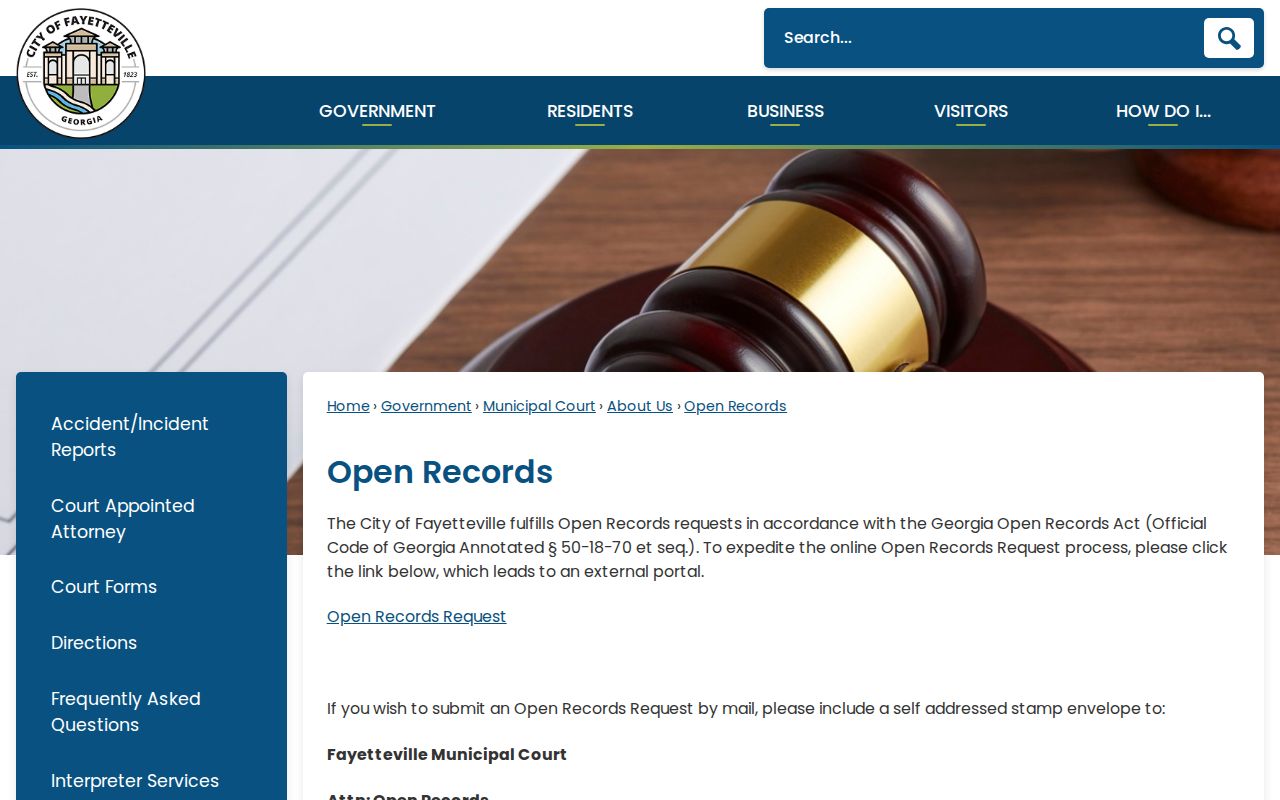
The form asks for date, case or citation number, requester contact information, requested record, stated reason, copies, a cost threshold, and signature. Supplying the case number narrows the search and can reduce avoidable staff time.
Municipal Court Records in Fayetteville
Fayetteville Municipal Court shares the police address at 760 Jimmie Mayfield Boulevard and can be reached at 770-719-4277. It hears traffic and city-ordinance violations. A certified copy or disposition costs $5 per case, and staff time after the first 15 minutes plus reproduction can be charged. A disposition is available 24 hours after adjudication.
| Court Name | Fayetteville Municipal Court |
|---|---|
| Case Types Heard | Traffic and city-ordinance violations assigned to the municipal court |
| Case Lookup Channel | Online, mail with SASE, fax, in person, or courtclerk@fayetteville-ga.gov |
| What the Docket Shows | Citation, scheduled events, plea or judgment, fine, and disposition |
| Copies & Fees | $5 per certified case copy or disposition; possible staff and reproduction charges |
Fayetteville Dispositions Take 24 Hours
A person who needs proof of a municipal outcome should allow 24 hours after adjudication before requesting the disposition. This short delay matters when a same-day inquiry returns no final entry. It does not mean the hearing failed to occur; it may mean the clerk has not completed the final record.
Ask specifically for a certified disposition when official proof of the outcome is needed. A payment receipt, police report, or online docket line is not necessarily the same document. For a felony or county misdemeanor outcome, request the record from the Fayette County Clerk rather than Fayetteville Municipal Court.
Where Fayetteville Records Go
Fayetteville Police retains the city-created investigative file. Municipal Court retains assigned traffic and ordinance cases. A felony or other county prosecution goes to the Fayette County courts, and reportable outcomes move into Georgia's criminal-history repository.
Record flow: Fayetteville Police Department › Fayette County Courts › Georgia Bureau of Investigation
Check police for the newest local narrative, the county jail for current custody, the correct court for the processed disposition, and GBI for the statewide history. The Fayette County overview explains the county and state layers without turning the Fayetteville page into a countywide directory.
Fayetteville Records Around the County Seat
Fayetteville is both a city and the Fayette County seat, which makes addresses easy to confuse. The city police and Municipal Court are at Jimmie Mayfield Boulevard. The county trial courts and Clerk are at the Fayette County Justice Center, 1 Center Drive. The Sheriff's jail is at 155 Johnson Avenue. A Fayetteville mailing address therefore does not identify the correct government custodian.
The city's civic history reinforces that distinction. Fayetteville was founded in 1823; its 1825 courthouse is described by the city as Georgia's oldest. A 1982 firebombing damaged the top floor before a nine-month restoration. Modern City Hall and City Center Park opened in 2021. The city's official City Hall page provides the contemporary civic setting.

City Hall imagery belongs to Fayetteville government, but criminal case files still follow the police, municipal, and county custody lines described above.
Public Access Rules in Fayetteville
Georgia public-record law supports inspection and copying of releasable Fayetteville records, subject to exemptions and court restrictions. Juvenile material, victim information, active investigative work, body-camera content, and protected personal data can require redaction or withholding. A cost notice or response within the statutory window is not a promise that production is already complete.
Key Statutes:
Georgia Open Records Act, O.C.G.A. § 50-18-71 - governs requests, inspection, copies, response, and lawful charges.
O.C.G.A. § 35-3-35 - regulates criminal-history dissemination and inspection.
O.C.G.A. § 35-3-37 - governs record restriction and correction procedures.
Fixing Fayetteville Record Errors
Trace an error back to its source. If the police narrative or identity is wrong, begin with Fayetteville Police. If the final charge or outcome is wrong, obtain the correct certified disposition from Municipal Court or the Fayette County Clerk. If the GCIC history still displays inaccurate information, use the source documentation in the state correction process. The repository cannot simply replace an originating record without support.
Record restriction is not the same as correction. Eligible cases may have public dissemination limited under Georgia law, but success should be verified in the relevant court view and in one's GCIC history. Different systems can update on different schedules.
A useful Fayetteville request identifies the document, not merely the topic. For a police file, state the report number if known, event date, address, and involved name. For Municipal Court, give the case or citation number and say whether an ordinary or certified copy is needed. For a county prosecution, use the county case number and defendant identifiers. These details reduce ambiguity when the same event has separate police and court numbering.
Preserve the response email, fax confirmation, mailed-request copy, or online receipt. The Municipal Court form lets a requester state a cost threshold; choose a realistic amount and wait for notice if the estimate exceeds it. Staff time after 15 minutes may be charged, so a narrow request can be both faster and less expensive than an open-ended demand for every record connected to a name.
When comparing results, work chronologically. A report records what was alleged at the beginning. A booking entry records custody and the charges then stated. A docket indexes court activity. The certified disposition proves the recorded conclusion. If those descriptions differ, the later court outcome should not be overwritten by the earlier allegation. It is normal for a criminal case to change as evidence is reviewed and charges are adjudicated.
Fayetteville requesters should also distinguish a missing record from a delayed one. Crash reports have a three-to-five-business-day availability window, and municipal dispositions have a 24-hour post-adjudication window. A search made earlier can be premature. Recheck after the published interval and use the relevant office directly before deciding that no official record exists.
Finally, public access is not the same as permission to reuse information for any purpose. Court and police records may include sensitive facts, and name matches may identify the wrong person. Use official identifiers, respect redactions, and verify an important conclusion with the office that created the document.