Finding Criminal Court Cases in Fayette County
The official starting point is the Fayette Clerk online-services page. It routes readers to court dockets, calendars, PeachCourt services, traffic payment, and related court tools. Georgia has no single official statewide public criminal-docket search, so a Fayette County case should be traced through the local court that owns it.
Use the defendant name, court, approximate year, and case number when known. Online entries are useful for orientation, but the Clerk warns that docket entries can appear without document images. A missing image is not a missing filing. Call the Criminal Division at 770-716-4293, inspect a public terminal, or request a named copy when the online view is not enough.
- Identify whether the matter is felony, misdemeanor, traffic, warrant-stage, or municipal.
- Check the Clerk links and calendar for Superior, State, or Magistrate Court.
- Compare the filed charge with the final disposition and sentence.
- Order or inspect the underlying document when proof is needed.
Which Fayette County Court Holds the Case?
Jurisdiction determines where a Fayette County criminal record lives. Superior Court has felony jury-trial jurisdiction. State Court hears misdemeanors and traffic matters. Magistrate Court handles warrants, first appearances, preliminary proceedings, and limited criminal work. Municipal courts handle their assigned city ordinance and traffic matters, so silence in the county Clerk view does not rule out a city case.
| Court | Typical criminal work | Best first contact |
|---|---|---|
| Superior Court | Felony accusations or indictments, pleas, trials, judgments, sentences | Clerk Criminal Division |
| State Court | Misdemeanors, traffic cases, and related calendars | Clerk or State Court |
| Magistrate Court | Warrants, first appearances, and preliminary process | Clerk or Magistrate Court |
| Municipal Court | City ordinance and assigned traffic cases | The named city court |
Peachtree City illustrates why the citation itself matters: a checked box can route the matter to Municipal Court, State Court, or Juvenile Court. Fayetteville and Tyrone also maintain municipal channels separate from the county criminal docket.
Inside a Fayette County Criminal Case File
A Fayette County court file may show the case number, court and division, defendant, filing dates, calendars, accusation or indictment, charge descriptions, docket events, motions, plea, judgment, sentence, and disposition. Probation-revocation events may also appear. Protected identifiers can be redacted, and sealed or restricted material is not open merely because related docket data once existed.
| Case identity | Case number, court, division, defendant, and filing dates |
|---|---|
| Charging paper | Accusation, indictment, complaint, or citation as applicable |
| Case activity | Arraignment, motions, hearing and trial calendar events |
| Outcome | Dismissal, nolle prosequi, acquittal, plea, judgment, and sentence |
| Document access | Docket entries may be online; images require a terminal inspection or copy order |
The court case number is not the same as a GCIC SID or Offender Tracking Number. A SID follows a fingerprint identity in state data. An OTN links an arrest cycle to disposition reporting. The court number identifies the judicial matter.
Fayette County Clerk Counter and Terminal Access
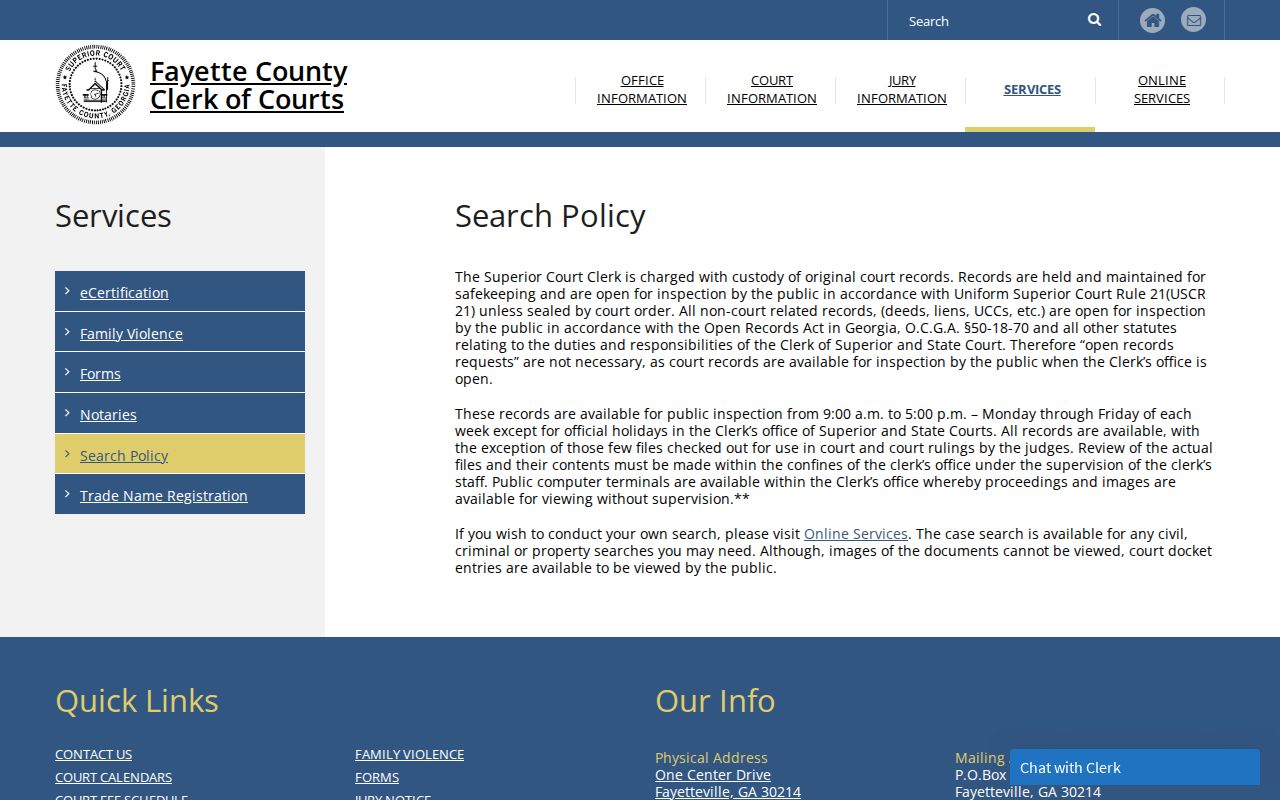
The Clerk search policy states that public inspection is available Monday through Friday, 9 a.m. to 5 p.m., excluding holidays. The Clerk is at the Fayette County Justice Center, 1 Center Drive, Fayetteville, Georgia 30214. Files stay in the office and are reviewed under staff supervision. Public terminals can display proceedings and images that the web docket does not show.
A file may be temporarily unavailable if it has been checked out for court. Call ahead when travel depends on seeing a specific Fayette County criminal case. Bring the case number, defendant name, and approximate year if available. Current security, device, and parking rules were not confirmed in the official research, so they should be verified with the office rather than assumed.
The official public inspection policy explains why the counter remains important.
Ordering Fayette County Criminal Court Copies
The Clerk criminal-copy form supports requests for an accusation or indictment, final disposition, or another named record. It asks for the defendant, case number, year, charge, and date of birth when known. Those fields help identification; the form says to provide as much information as possible rather than making every field an absolute condition.
| Form item | How it helps |
|---|---|
| Defendant and date of birth | Distinguish people with similar names |
| Case number and year | Locate the correct court file |
| Charge | Narrow the requested matter |
| Document and quantity | Specify disposition, charging paper, or other copy |
| Return choice | Mail or eligible email delivery |
Certified and restricted copies cannot be returned by email. Mail requests go to Clerk of Superior Court, Attn: Criminal Records, Fayette Justice Center, 1 Center Drive, Fayetteville, GA 30214. The form permits phone card payment after processing with Discover, MasterCard, or Visa, and mail payment by business check, money order, or cashier's check. The current fee schedule controls because prices can change.
From Fayette County Arrest to Final Disposition
A typical Fayette County criminal case can move from arrest and jail booking to a Magistrate first appearance, then to a prosecutor's accusation or a grand jury indictment. Arraignment, motions, calendars, plea negotiations, trial, judgment, sentence, and appeal may follow. Not every arrest reaches each stage, and charges can be reduced, replaced, split, or dismissed.
That is why a recent booking is only the start of the evidence chain. The official Fayette County arrest lookup channels may establish custody and the initial allegation, while the Clerk file establishes what was filed and how it ended. A certified final disposition is stronger proof of outcome than a screenshot of a docket summary.
Read the endpoint: An arrest allegation does not become a conviction unless the court record shows a guilty judgment.
When Fayette County Online Dockets Fall Short
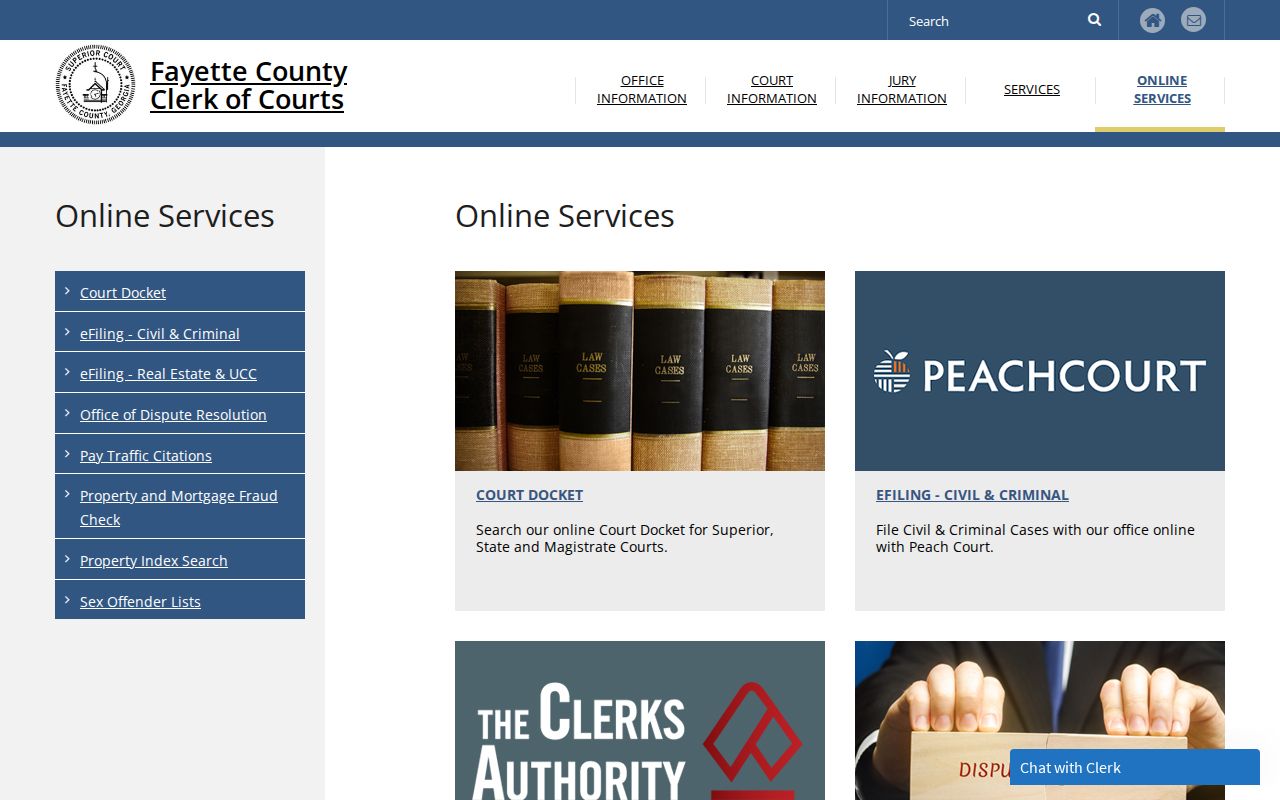
The county online-service page is a directory of linked systems, not a promise that every Fayette County criminal document is freely visible by name. PeachCourt should not be described as a free and complete county query without checking its access and payment conditions. The county Indexed Records Name Search appears oriented to indexed or property records and is not a substitute for the criminal docket.
When an older case, image, or disposition is absent, use a deliberate fallback chain: call 770-716-4293, inspect the Justice Center terminals, and submit the criminal-copy form for the exact document. If the matter began with a city citation, contact that municipal court. If it is only at the warrant or preliminary stage, Magistrate records may explain the early paper trail.
The official online services screen collects the Clerk's docket and calendar routes.
Public Access Limits on Fayette County Court Records
Uniform Superior Court Rule 21 makes court records public unless access is lawfully limited. The Georgia Open Records Act governs many agency records, but court-file access also follows judicial rules. Juvenile material, sealed records, protected identifiers, and other lawfully restricted information may be withheld or redacted.
Georgia record restriction under O.C.G.A. §35-3-37 generally limits public dissemination of eligible history; it does not destroy every record. A restricted GCIC entry, a sealed court document, and a police report are distinct records controlled by different custodians. If the source is wrong, obtain documentation from the court or agency that originated it because GCIC cannot unilaterally rewrite source data.
Fayette County Accountability Court Context
Fayette State Court publishes named DUI/Drug and Veterans treatment programs. These programs can matter to the path and conditions of an eligible case, but their existence does not show that every person with a substance-related or service-connected issue qualifies. The court and program must determine eligibility.
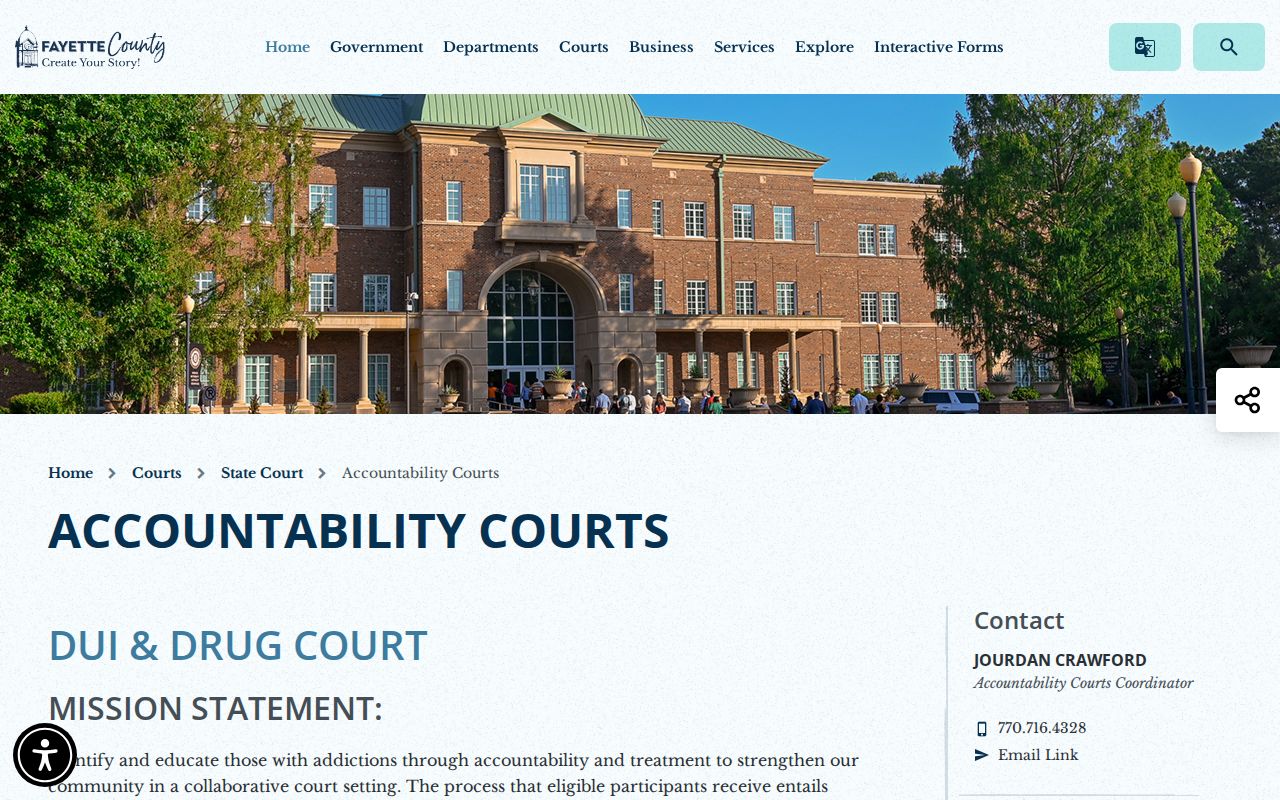
The county accountability court page is the official source for current program details. A docket reader should still focus on the orders, plea, conditions, and final disposition in the individual file.
The county's official program page identifies the local accountability courts.
Fayette County Justice Center Court Directory
The county court directory helps separate Superior, State, Magistrate, Probate, and other functions at 1 Center Drive. Probate Court is in the Justice Center but is not the criminal-case custodian. The Sheriff's Office and jail at 155 Johnson Avenue are a different records node for booking and custody information.
The official directory shows the Justice Center's court structure and contacts.